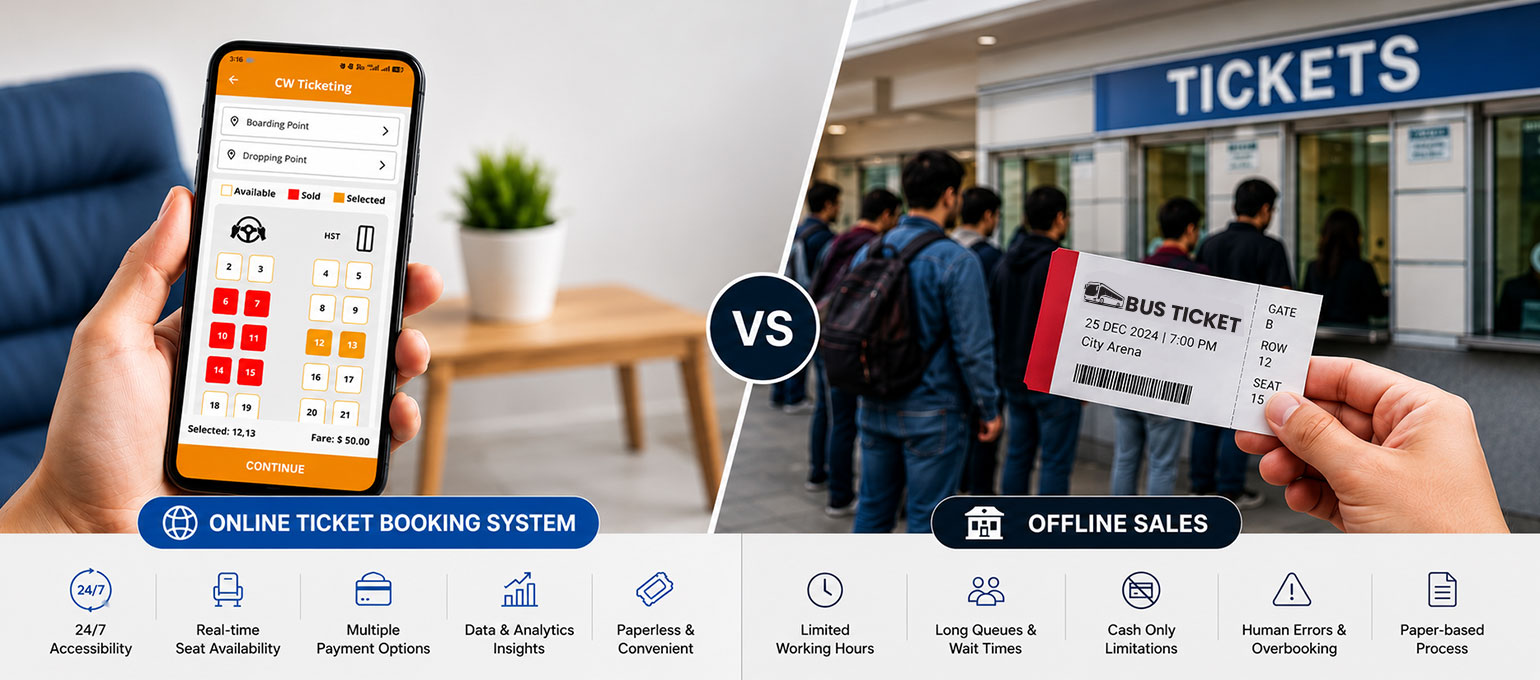
Online ticketing vs. offline ticketing —Transport operators often struggle with choosing the right ticket booking system. For some, offline ticketing seems to do the job, while those looking to maximize their revenues and support long-term growth prefer an online booking system.
But for most businesses, the real concern is how to balance both channels to maximize success and improve customer experience.
Let’s understand the strengths and limitations of each channel that can help operators build a more effective sales strategy.
Customer Reach
Offline ticket booking: Sales are naturally limited by geography. A physical counter or agent network can only serve customers within a specific area. This approach works well for established routes with strong local demand, but expanding into new markets often requires significant investment. Additionally, these days, most people prefer digital ticket booking. So even with a strong offline establishment, offline ticketing might feel inconvenient for many customers.
Online ticket booking: It removes those barriers we stated right above. With an online ticketing solution, passengers can discover routes, compare schedules, and book tickets from anywhere at any time. For operators looking to attract travellers beyond their immediate service area, an online ticketing platform offers a much broader reach.
Operating Costs
Maintaining offline sales channels involves higher operational expenses. Ticket counters require staff, physical infrastructure, and ongoing administration. As networks grow, so do these costs.
Online booking platforms, on the other hand, reduce much of that overhead. Once the system is established, it can process bookings immediately. It helps to lower administrative workloads as well as reduce dependency on manual operations. This efficiency becomes immensely valuable during peak travel seasons when booking volumes rise sharply.
Customer Support
One area where offline booking continues to excel is customer service.
Many passengers still prefer speaking with a representative when making their booking. The option works well, especially for group bookings, sudden schedule changes, or special travel requirements. Most customers prefer a knowledgeable agent who can answer unprompted questions and resolve concerns immediately.
Online systems eliminate the travel to the counter, but sometimes, they rely solely on automated support tools. While these tools handle routine inquiries efficiently, they may not always provide the human reassurance or flexibility that some customers expect.
However, many travel businesses have adopted the hybrid path of offering both chatbots and human support to their passengers. This combined approach proves to be more effective in providing a more dynamic response to customer queries.
Scalability
Expanding an offline sales network usually requires hiring staff, opening new locations, partnering with additional agents, and so on. Here, growth is possible, but it comes with increased complexity and cost.
Online ticketing is inherently more scalable. Whether an operator processes 100 bookings or 10,000, the same digital infrastructure can support that growth with minimal additional resources. For operators planning to expand routes or enter new regions, online ticketing offers a significantly better solution than an offline system.
Data Collection and Business Insights
Offline sales provide limited visibility into customer behavior. Operators may know how many tickets were sold, but understanding booking patterns, customer preferences, and booking trends becomes extremely difficult as the business grows.
Online platforms generate valuable data with every transaction. Operators can track booking sources, travel trends, occupancy rates, and customer demographics. These insights support better pricing decisions and more accurate marketing campaigns.
Brand Visibility
Offline presence builds strong local recognition. A well-known ticket counter or agent network can become a trusted part of the community and generate repeat business over time.
However, online channels extend this visibility globally. A transport operator with digital booking capabilities can reach customers across cities, regions, or even countries. These opportunities are difficult to achieve through offline channels alone.
Related Blog: Manage Nationwide Fleet From Anywhere with Automated Bus Ticketing System
Which Transport Ticket Booking Model is Right for You?
The most successful transport businesses rarely rely entirely on either offline or online ticket sales.
For smaller operators, maintaining local counters while introducing online booking can expand reach without disrupting existing customer relationships.
Mid-sized and larger operators, meanwhile, can use online ticketing software as their primary growth engine while maintaining strategic offline touchpoints for sensitive parts such as customer service and high-value partnerships.
Businesses that combine both offline and online ticket booking systems effectively are better positioned to serve diverse customer segments, efficiently manage operations, increase revenue, and compete in the long term.
Not sure which ticketing model is right for your transport business? Speak with the CWTicketing team for practical advice tailored to your routes, passengers, and growth goals.
Related Blog: SaaS vs On-Premise Solution for Ticketing Businesses


Leave a Reply